
1. Status of This Document
This section describes the status of this document at the time of its publication.
This is a work in progress and is subject to change. This document is maintained by the ODI Development Team and is intended to serve as a reference for standardized data modeling practices.
2. Introduction
This specification defines the Social Care Case Management System data model for structuring and organizing data in a standardized format. The data model provides a foundation for consistent data representation, validation, and exchange across different systems and applications.
2.1. Purpose and Scope
This data model aims to:
-
Provide a clear and consistent structure for data representation
-
Enable interoperability between different systems
-
Support extensibility for future enhancements
-
Facilitate data validation and quality assurance
3. Key Concepts
This section introduces the fundamental concepts that form the basis of the data model.
3.1. Core Principles
The data model is built on the following core principles:
-
Consistency: Data structures follow consistent patterns and naming conventions
-
Extensibility: The model can be extended to accommodate new requirements
-
Interoperability: Data can be exchanged between different systems
-
Validation: Data structures include validation rules to ensure data quality
4. Data Model
This section defines the core data structures and their relationships for social care case management systems. The data model described in the following sections reuses existing standards and vocabularies which have then been extended to cover the additional requirements needs to support the publication of consumption of Social Care data.
4.1. Namespaces
The rest of this specification makes use of the following namespaces:
dc:http://purl.org/dc/terms/schema:https://schema.org/skos:http://www.w3.org/2004/02/skos/core#sc:https://socialcare.io/
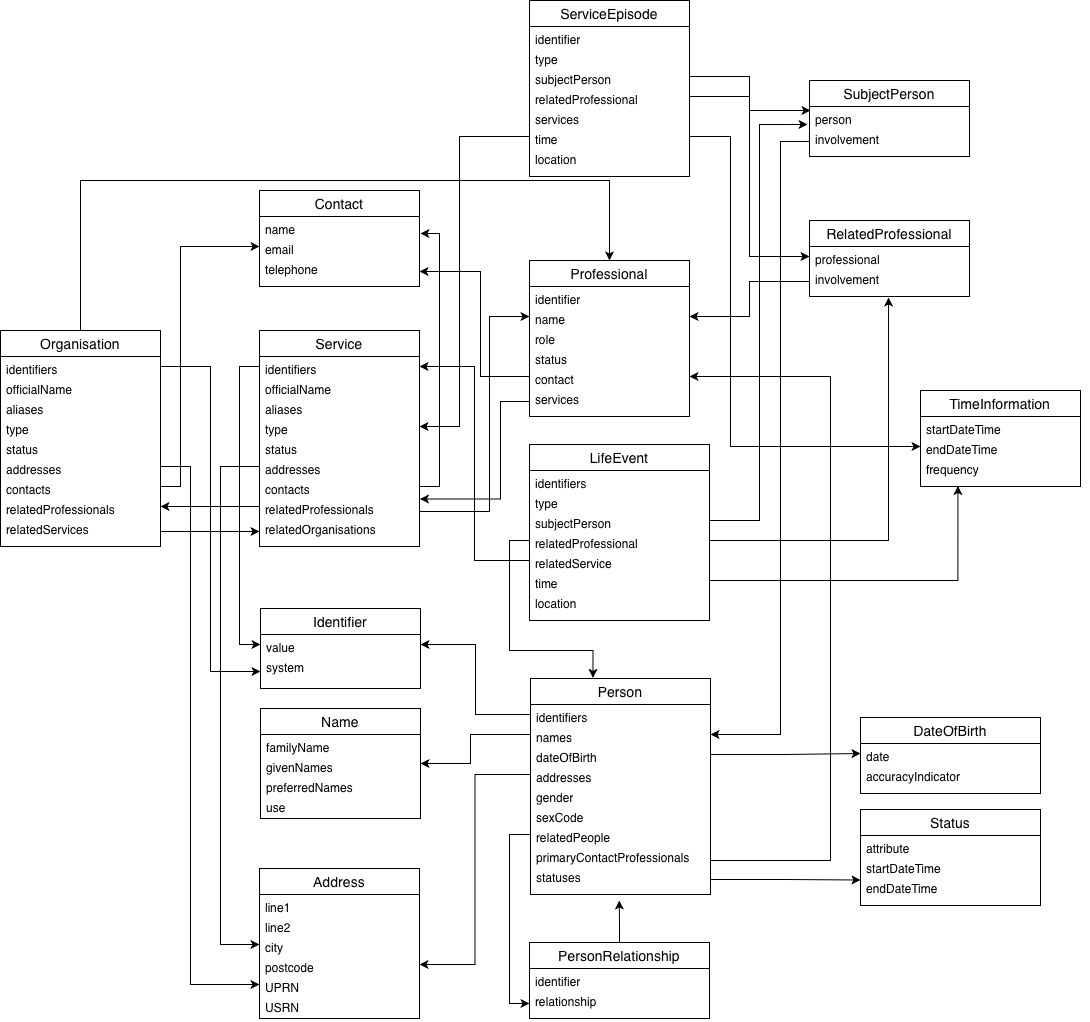
4.2. Data Model Diagram
This diagram illustrates the resources and relationships that are introduced in the following sections.
4.2.1. Describing Person (sc:Person)
The Person entity defines the standardized structure for representing individuals within the unified data model. It consolidates core identity attributes required to uniquely distinguish one person from another and to establish relationships between individuals.
This entity is designed to support interoperability across children’s and adult social care systems, enabling consistent identification and linkage of records. Its primary purpose is to facilitate the implementation of “Single View” systems, thereby improving multi-agency information sharing and coordination.
| Field | Status | Type | Description / Alignment |
|---|---|---|---|
identifiers
| REQUIRED | Array of Identifier | Unique identifiers associated with the person. |
names
| REQUIRED | Array of Name | Container for name parts. |
dateOfBirth
| REQUIRED | DateOfBirth | The person's date of birth. |
addresses
| OPTIONAL | Array of Address | Physical location(s) where the person can be contacted. |
gender
| REQUIRED | String: PersonGenderCode | The person’s stated gender. (Non-biological). |
sexCode
| OPTIONAL | String: PersonSexCode | Observed phenotypic sex, where recorded. |
relatedPeople
| OPTIONAL | Array of PersonRelationship | References to other people related to this person. |
primaryContactProfessionals
| OPTIONAL | Array of Professional IDs | References to the primary professionals related to this person. For example, care coordinators or a GP. |
statuses
| OPTIONAL | Array of Status | References to the person's current statuses (eg. disability, free school meals). |
The following example shows a simple person description:
{ "type" : "Person" , "identifiers" : [ { "type" : "Identifier" , "value" : "9434765919" , "system" : "https://fhir.nhs.uk/Id/nhs-number" } ], "names" : [ { "type" : "Name" , "familyName" : [ "Doe" ], "givenNames" : [ "John" ], "preferredNames" : "John Doe" , "use" : "official" } ], "dateOfBirth" : { "type" : "DateOfBirth" , "date" : "2017-09-01" , "accuracyIndicator" : "AAA" }, "addresses" : [ { "type" : "Address" , "line1" : "1 High Street" , "city" : "Anytown" , "postcode" : "AB1 2CD" } ], "gender" : "1" }
4.2.2. Describing Professional (sc:Professional)
A professional is an individual acting in a formal role within an organisation who has responsibilities relating to an individual’s safety, wellbeing, care or support. Professionals will work with individuals in a range of ways, which can include undertaking assessments, creating and monitoring plans or sharing information within a multiagency context.
A professional’s involvement can be ongoing or relate to a specific service episode, and multiple professionals can work with an individual at any one time from a range of agencies.
| Field | Status | Type | Description / Alignment |
|---|---|---|---|
identifiers
| REQUIRED | Array of Identifier | Unique identifiers (IDs) associated with the professional. |
name
| REQUIRED | Name | Container for the professional's name parts. |
role
| REQUIRED | Array of String | Text to describe professional's occupational role, eg. their position in an organogram. |
status
| OPTIONAL | Array of String: StatusCode | Code for the professional's current working status |
personalContact
| OPTIONAL | Contact | Professional's preferred contact details. |
services
| OPTIONAL | Array of Service | References to Service(s) the professional is related to. |
organisations
| OPTIONAL | Array of Organisation | References to Organisation(s) the professional is related to. |
The following example shows a simple professional description:
{ "type" : "Professional" , "identifiers" : [ { "type" : "Identifier" , "value" : "PROF-0001" , "system" : "https://example.org/identifier/local-professional-id" } ], "name" : { "type" : "Name" , "familyName" : [ "Smith" ], "givenNames" : [ "Alex" ] }, "role" : [ "Social care worker" ], "personalContact" : { "type" : "Contact" , "name" : "Work" , "email" : [ "alex.smith@example.org" ], "telephone" : [ "+44 20 7946 0000" ] }, "organisations" : [ "https://example.org/organisations/LOCAL-AUTH-001" ] }
4.2.3. Describing Service (sc:Service)
TODO add description
| Field | Status | Type | Description / Alignment |
|---|---|---|---|
identifiers
| REQUIRED | Array of Identifier | Unique identifiers (IDs) associated with the service. |
officialName
| REQUIRED | String | Official name of the service. |
aliases
| OPTIONAL | Array of String | Aliases the service is known by. |
type
| REQUIRED | Array of ServiceCode | Code for the kind of the service. |
status
| OPTIONAL | Array of String: StatusCode | Code for the service's status. |
addresses
| OPTIONAL | Array of Address | Physical location(s) of the service. |
contacts
| OPTIONAL | Array of Contact | Service contact details. |
relatedProfessionals
| OPTIONAL | Array of Professional | References to Professional(s) involved in the service. |
relatedOrganisations
| OPTIONAL | Array of Organisation | References to Organisation(s) involved in the provision of the service. |
4.2.4. Describing Service Episode (sc:ServiceEpisode)
A service episode is a bounded period during which an individual receives a defined service, intervention, or package of support from a service or professional. It has a recognisable start and end point, though duration may vary from a single contact to sustained involvement over time.
A service episode represents structured engagement rather than a single interaction, and may include multiple contacts, assessments, reviews, or actions within its timeframe. Individuals may experience multiple concurrent or sequential service episodes across different services or organisations.
While a single service episode may reflect routine support, changes in the number, intensity, duration, or overlap of service episodes may indicate shifts in need, complexity, risk, or stability. Patterns of service episodes over time contribute to understanding an individual’s care trajectory and system involvement.
Describing a service episode requires describing a service -- an organisation that is involved in the safeguarding or wellbeing of a person. This could be a social care department of a local authority, an A&E department or GP, a school or education authority, or anything else that may support a person or intervene in their lives.
| Field | Status | Type | Description / Alignment |
|---|---|---|---|
identifiers
| REQUIRED | Array of Identifier | Unique identifiers (IDs) associated with the service episode. |
type
| REQUIRED | Array of String: EpisodeCode | Code for the type of episode. |
subjectPerson
| REQUIRED | Array of SubjectPerson | References to Person(s) involved in the episode. |
relatedProfessional
| OPTIONAL | Array of RelatedProfessional | References to Professional(s) involved in the episode. |
services
| REQUIRED | Array of: Service | References to Service(s) involved in the episode. |
time
| REQUIRED | Array of TimeInformation | Details about timing of the episode. |
location
| REQUIRED | Array of String | Details about the location of the episode. |
4.2.5. Desribing Organisation (sc:Organisation)
TODO add description
| Field | Status | Type | Description / Alignment |
|---|---|---|---|
identifiers
| REQUIRED | Array of Identifier | Unique identifiers (IDs) associated with the organisation. |
officialName
| REQUIRED | String | Official name of the organisation. |
aliases
| OPTIONAL | Array of String | Aliases the organisation is known by. |
type
| REQUIRED | Array of OrganisationCode | Code for the kind of the organisation. |
status
| OPTIONAL | Array of String: StatusCode | Code for the organisation's status. |
addresses
| OPTIONAL | Array of Address | Physical location(s) of the organisation. |
contacts
| OPTIONAL | Array of Contact | Organisation contact details. |
relatedProfessionals
| OPTIONAL | Array of Professional | References to Professional(s) that are associated with the organisation. |
relatedServices
| REQUIRED | Array of Service | References to Service(s) that the organisation provides or contributes to the provision of. |
4.2.6. Describing Life Event (sc:LifeEvent)
A life event is a significant, time-bound occurence in an individual’s life that may have implications for their safety, wellbeing or development. They are not inherently positive or negative, but can indicate to safeguarding and wellbeing professionals levels of risk, vulnerability, need or changes in support requirements. Examples of life events in this space could include attendance at A+E, a child being reported as missing or an exclusion from school.
Safeguarding professionals will be interested in the recency of events (when the event most recently happened), frequency (how frequently that incident is occurring), gravity (how serious the incident is when it occurs) and how the event combines with other events and factors in the individual’s life to ascertain the support needs.
| Field | Status | Type | Description / Alignment |
|---|---|---|---|
identifiers
| REQUIRED | Array of Identifier | Unique identifiers (IDs) associated with the service episode. |
type
| REQUIRED | Array of String: EventCode | Code for the type of the life event (e.g. birth, death). |
subjectPerson
| REQUIRED | Array of SubjectPerson | References to Person(s) involved in the life event. |
relatedProfessional
| OPTIONAL | Array of RelatedProfessional | References to Professional(s) involved in the life event. |
services
| OPTIONAL | Array of: Service | References to Service(s) involved in the life event. |
time
| REQUIRED | Array of TimeInformation | Details about timing of the life event. |
location
| REQUIRED | Array of String | Details about the location of the life event. |
4.2.7. Describing Identifier (sc:Identifier)
Unique identifier (IDs) definition. It aligns with FHIR Identifier and PDS UNIQUE_REFERENCE definitions
| Field | Status | Type | Description / Alignment |
|---|---|---|---|
value
| REQUIRED | String | Unique identifiers associated with the entity. |
system
| REQUIRED | URI | System that the identifier adheres to (e.g., https://fhir.nhs.uk/Id/nhs-number). |
4.2.8. Describing Name (sc:Name)
Container for name parts. It aligns with FHIR HumanName.
| Field | Status | Type | Description / Alignment |
|---|---|---|---|
familyName
| REQUIRED | Array of String | Surname or family name. |
givenNames
| REQUIRED | Array of String | First and middle names. |
preferredNames
| OPTIONAL | String | Any preferred names used by the person. |
use
| OPTIONAL | String: NameUse | Any preferred names used by the person. |
4.2.9. Describing Date of Birth (sc:DateOfBirth)
Container for the person’s date of birth. It aligns with FHIR Patient.birthDate.
| Field | Status | Type | Description / Alignment |
|---|---|---|---|
date
| REQUIRED | Date | ISO8601 formatted date of birth (YYYY-MM-DD). |
accuracyIndicator
| RECOMMENDED | String: DateAccuracyIndicator | Indicates which parts of the date are known to be accurate (A), estimated (E) or unknown (U). |
4.2.10. Describing Address (sc:Address)
An address expressed using postal conventions (as opposed to GPS or other location definition formats). It aligns with FHIR Address.
| Field | Status | Type | Description / Alignment |
|---|---|---|---|
line1
| REQUIRED | String | Street address, c/o. |
line2
| OPTIONAL | String | Apartment, suite, unit, building, floor, etc. |
city
| REQUIRED | String | City, town, or village. |
postcode
| REQUIRED | String | Postcode for address. |
UPRN
| OPTIONAL | Float16 | Unique Property Reference Number of the address. |
USRN
| OPTIONAL | Float16 | Unique Street Reference Number of the address. |
4.2.11. Describing Contact (sc:Contact)
Container for contact information.
| Field | Status | Type | Description / Alignment |
|---|---|---|---|
name
| RECOMMENDED | String | Name of the contact type, eg. "Home", "Work", "Other" |
email
| OPTIONAL | Array of String | Email address |
telephone
| OPTIONAL | Array of String | Telephone Number |
4.2.12. Describing Person Relationship (sc:PersonRelationship)
References to other people related to a person.
| Field | Status | Type | Description / Alignment |
|---|---|---|---|
identifier
| REQUIRED | Identifier | A reference to another Person identifier. |
relationship
| REQUIRED | Array of String: PersonRelationshipCode | Code for the kind of the relationship. |
The following example demonstrates a simple family membership relationship between two people:
{ "type" : "Person" , "identifiers" : [ { "value" : "CHILD-0001" , "system" : "https://example.org/identifier/local-person-id" } ], "names" : [ { "familyName" : [ "Taylor" ], "givenNames" : [ "Jamie" ] } ], "relatedPeople" : [ { "type" : "PersonRelationship" "identifier" : { "value" : "12345" , "system" : "https://example.org/identifier/local-person-id" }, "relationship" : [ "FAMMEMB" ] } ] }, { "type" : "Person" , "identifiers" : [ { "value" : "12345" , "system" : "https://example.org/identifier/local-person-id" } ], "names" : [ { "familyName" : [ "Taylor" ], "givenNames" : [ "Morgan" ] } ] }
4.2.13. Desribing Status (sc:Status)
A Status to describe the type of status (eg. disability, free schoo meals).
| Field | Status | Type | Description / Alignment |
|---|---|---|---|
attribute
| REQUIRED | String: StatusCode | A StatusCode to describe the type of status (eg. disability, free schoo meals). |
startDateTime
| REQUIRED | Date | DateTime (ISO-8601) for start of the life event. |
endDateTime
| OPTIONAL | Date | DateTime (ISO-8601) for end of the life event. |
4.2.14. Describing Subject Person (sc:SubjectPerson)
Person(s) involved in the episode.
| Field | Status | Type | Description / Alignment |
|---|---|---|---|
person
| REQUIRED | Person | A reference to a Person record involved in the episode. |
involvement
| REQUIRED | String : PersonInvolvementCode | Code for the nature of the Person's involvement in the episode. |
4.2.15. Describing Related Professional (sc:RelatedProfessional)
Professional(s) involved in the episode.
| Field | Status | Type | Description / Alignment |
|---|---|---|---|
professional
| REQUIRED | Professional | A reference to a Professional record involved in the episode. |
involvement
| REQUIRED | String : ProfessionalInvolvementCode | Code for the nature of the Professional's involvement in the episode. |
4.2.16. Describing Time Information (sc:TimeInformation)
Timing of the episode.
| Field | Status | Type | Description / Alignment |
|---|---|---|---|
startDateTime
| REQUIRED | DateTime | DateTime (ISO-8601) for start of the episode. |
endDateTime
| OPTIONAL | DateTime | DateTime (ISO-8601) for end of the episode. |
frequency
| OPTIONAL | String: FrequencyCode | Expected frequency of the episode, incl. whether spontaneous or not. |
5. Vocabularies
5.1. Name Use
Corresponds to FHIR Name Use and indicates the intended purpose of this name. It allows applications to select the appropriate name for a specific context from a set of names. Names can be assumed to be current unless explicitly marked as temporary or old.
| Code | Description |
|---|---|
usual
| Known as/conventional/the one you normally use. |
official
| The formal name as registered in an official (government) registry, but which name might not be commonly used. May be called "legal name". |
temp
| A temporary name. Name.period can provide more detailed information. This may also be used for temporary names assigned at birth or in emergency situations. |
nickname
| A name that is used to address the person in an informal manner, but is not part of their formal or usual name. |
anonymous
| Anonymous assigned name, alias, or pseudonym (used to protect a person's identity for privacy reasons). |
old
| This name is no longer in use (or was never correct, but retained for records). |
maiden
| A name used prior to changing name because of marriage. This name use is for use by applications that collect and store names that were used prior to a marriage. Marriage naming customs vary greatly around the world, and are constantly changing. This term is not gender specific. The use of this term does not imply any particular history for a person's name. |
5.2. Date Accuracy Indicator
Corresponds to FHIR Date Accuracy Indicator. A three-character code (DDMMYYYY → DMY order) indicating the accuracy of each date component:
-
A – Accurate
-
E – Estimated
-
U – Unknown
Positions:
-
1st character → Day
-
2nd character → Month
-
3rd character → Year
Example:
-
AAA – Fully accurate date
-
UUE – Day and month unknown, year estimated
-
UAA – Day unknown, month and year accurate
5.3. Person Gender Code
The person’s stated gender. This information does not pertain to biological sex. It aligns with FHIR PersonStatedGenderCode and PDS PERSON_STATED_GENDER_CODE definitions.
| Code | Display | Description |
|---|---|---|
1
| Male | The person identifies as male. |
2
| Female | The person identifies as female. |
9
| Indeterminate | Unable to be classified as either male or female. |
X
| Not Known | Not recorded or information is unavailable. |
5.4. Person Sex Code
Observed phenotypic sex. It aligns with PDS PERSON PHENOTYPIC SEX definitions.
| Code | Display | Description |
|---|---|---|
1
| Male | The person identifies as male. |
2
| Female | The person identifies as female. |
9
| Indeterminate | Unable to be classified as either male or female. |
X
| Not Known | Not recorded or information is unavailable. |
5.5. Person Relationship Code
Types of personal relationships between two living subjects (ex. parent, sibling, unrelated friend, neighbor). It aligns with FHIR PersonalRelationshipRoleType definitions.
| Code | Display | Description |
|---|---|---|
FAMMEMB
| family member | A relationship between two people characterizing their "familial" relationship. |
CHILD
| child | The player of the role is a child of the scoping entity. |
CHLDADOPT
| adopted child | The player of the role is a child taken into a family through legal means and raised by the scoping person (parent) as his or her own child. |
DAUADOPT
| adopted daughter | The player of the role is a female child taken into a family through legal means and raised by the scoping person (parent) as his or her own child. |
SONADOPT
| adopted son | The player of the role is a male child taken into a family through legal means and raised by the scoping person (parent) as his or her own child. |
CHLDFOST
| foster child | The player of the role is a child receiving parental care and nurture from the scoping person (parent) but not related to him or her through legal or blood ties. |
DAUFOST
| foster daughter | The player of the role is a female child receiving parental care and nurture from the scoping person (parent) but not related to him or her through legal or blood ties. |
SONFOST
| foster son | The player of the role is a male child receiving parental care and nurture from the scoping person (parent) but not related to him or her through legal or blood ties. |
DAUC
| daughter | The player of the role is a female child (of any type) of scoping entity (parent). |
DAU
| natural daughter | The player of the role is a female offspring of the scoping entity (parent). |
STPDAU
| stepdaughter | The player of the role is a daughter of the scoping person's spouse by a previous union. |
NCHILD
| natural child | The player of the role is an offspring of the scoping entity as determined by birth. |
SON
| natural son | The player of the role is a male offspring of the scoping entity (parent). |
SONC
| son | The player of the role is a male child (of any type) of scoping entity (parent). |
STPSON
| stepson | The player of the role is a son of the scoping person's spouse by a previous union. |
STPCHLD
| step child | The player of the role is a child of the scoping person's spouse by a previous union. |
EXT
| extended family member | A family member not having an immediate genetic or legal relationship, e.g. aunt, cousin, great grandparent, grandchild, grandparent, niece, nephew or uncle. |
AUNT
| aunt | The player of the role is a sister of the scoping person's mother or father. |
MAUNT
| maternal aunt | The player of the role is a biological sister of the scoping person's biological mother. |
PAUNT
| paternal aunt | The player of the role is a biological sister of the scoping person's biological father. |
COUSN
| cousin | The player of the role is a relative of the scoping person descended from a common ancestor, such as a grandparent, by two or more steps in a diverging line. |
MCOUSN
| maternal cousin | The player of the role is a biological relative of the scoping person descended from a common ancestor on the player's mother's side, such as a grandparent, by two or more steps in a diverging line. |
PCOUSN
| paternal cousin | The player of the role is a biological relative of the scoping person descended from a common ancestor on the player's father's side, such as a grandparent, by two or more steps in a diverging line. |
GGRPRN
| great grandparent | The player of the role is a parent of the scoping person's grandparent. |
GGRFTH
| great grandfather | The player of the role is the father of the scoping person's grandparent. |
MGGRFTH
| maternal great-grandfather | The player of the role is the biological father of the scoping person's biological mother's parent. |
PGGRFTH
| paternal great-grandfather | The player of the role is the biological father of the scoping person's biological father's parent. |
GGRMTH
| great grandmother | The player of the role is the mother of the scoping person's grandparent. |
MGGRMTH
| maternal great-grandmother | The player of the role is the biological mother of the scoping person's biological mother's parent. |
PGGRMTH
| paternal great-grandmother | The player of the role is the biological mother of the scoping person's biological father's parent. |
MGGRPRN
| maternal great-grandparent | The player of the role is a biological parent of the scoping person's biological mother's parent. |
PGGRPRN
| paternal great-grandparent | The player of the role is a biological parent of the scoping person's biological father's parent. |
GRNDCHILD
| grandchild | The player of the role is a child of the scoping person's son or daughter. |
GRNDDAU
| granddaughter | The player of the role is a daughter of the scoping person's son or daughter. |
GRNDSON
| grandson | The player of the role is a son of the scoping person's son or daughter. |
GRPRN
| grandparent | The player of the role is a parent of the scoping person's mother or father. |
GRFTH
| grandfather | The player of the role is the father of the scoping person's mother or father. |
MGRFTH
| maternal grandfather | The player of the role is the biological father of the scoping person's biological mother. |
PGRFTH
| paternal grandfather | The player of the role is the biological father of the scoping person's biological father. |
GRMTH
| grandmother | The player of the role is the mother of the scoping person's mother or father. |
MGRMTH
| maternal grandmother | The player of the role is the biological mother of the scoping person's biological mother. |
PGRMTH
| paternal grandmother | The player of the role is the biological mother of the scoping person's biological father. |
MGRPRN
| maternal grandparent | The player of the role is the biological parent of the scoping person's biological mother. |
PGRPRN
| paternal grandparent | The player of the role is the biological parent of the scoping person's biological father. |
INLAW
| inlaw | A relationship between an individual and a member of their spousal partner's immediate family. |
CHLDINLAW
| child-in-law | The player of the role is the spouse of scoping person's child. |
DAUINLAW
| daughter in-law | The player of the role is the wife of scoping person's son. |
SONINLAW
| son in-law | The player of the role is the husband of scoping person's daughter. |
PRNINLAW
| parent in-law | The player of the role is the parent of scoping person's husband or wife. |
FTHINLAW
| father-in-law | The player of the role is the father of the scoping person's husband or wife. |
MTHINLAW
| mother-in-law | The player of the role is the mother of the scoping person's husband or wife. |
MTHINLOAW
| mother-in-law | The player of the role is the mother of the scoping person's husband or wife. |
SIBINLAW
| sibling in-law | The player of the role is: (1) a sibling of the scoping person's spouse, or (2) the spouse of the scoping person's sibling, or (3) the spouse of a sibling of the scoping person's spouse. |
BROINLAW
| brother-in-law | The player of the role is: (1) a brother of the scoping person's spouse, or (2) the husband of the scoping person's sister, or (3) the husband of a sister of the scoping person's spouse. |
SISINLAW
| sister-in-law | The player of the role is: (1) a sister of the scoping person's spouse, or (2) the wife of the scoping person's brother, or (3) the wife of a brother of the scoping person's spouse. |
SISLINLAW
| sister-in-law | The player of the role is: (1) a sister of the scoping person's spouse, or (2) the wife of the scoping person's brother, or (3) the wife of a brother of the scoping person's spouse. |
NIENEPH
| niece/nephew | The player of the role is a child of scoping person's brother or sister or of the brother or sister of the scoping person's spouse. |
NEPHEW
| nephew | The player of the role is a son of the scoping person's brother or sister or of the brother or sister of the scoping person's spouse. |
NIECE
| niece | The player of the role is a daughter of the scoping person's brother or sister or of the brother or sister of the scoping person's spouse. |
UNCLE
| uncle | The player of the role is a brother of the scoping person's mother or father. |
MUNCLE
| maternal uncle | The player of the role is a biological brother of the scoping person's biological mother. |
PUNCLE
| paternal uncle | The player of the role is a biological brother of the scoping person's biological father. |
PRN
| parent | The player of the role is one who begets, gives birth to, or nurtures and raises the scoping entity (child). |
ADOPTP
| adoptive parent | The player of the role (parent) has taken the scoper (child) into their family through legal means and raises them as his or her own child. |
ADOPTF
| adoptive father | The player of the role (father) is a male who has taken the scoper (child) into their family through legal means and raises them as his own child. |
ADOPTM
| adoptive mother | The player of the role (father) is a female who has taken the scoper (child) into their family through legal means and raises them as her own child. |
FTH
| father | The player of the role is a male who begets or raises or nurtures the scoping entity (child). |
FTHFOST
| foster father | The player of the role (parent) who is a male state-certified caregiver responsible for the scoper (child) who has been placed in the parent's care. The placement of the child is usually arranged through the government or a social-service agency, and temporary. The state, via a jurisdiction recognized child protection agency, stands as in loco parentis to the child, making all legal decisions while the foster parent is responsible for the day-to-day care of the specified child. |
NFTH
| natural father | The player of the role is a male who begets the scoping entity (child). |
NFTHF
| natural father of fetus | Indicates the biologic male parent of a fetus. |
STPFTH
| stepfather | The player of the role is the husband of scoping person's mother and not the scoping person's natural father. |
MTH
| mother | The player of the role is a female who conceives, gives birth to, or raises and nurtures the scoping entity (child). |
GESTM
| gestational mother | The player is a female whose womb carries the fetus of the scoper. Generally used when the gestational mother and natural mother are not the same. |
MTHFOST
| foster mother | The player of the role (parent) who is a female state-certified caregiver responsible for the scoper (child) who has been placed in the parent's care. The placement of the child is usually arranged through the government or a social-service agency, and temporary. The state, via a jurisdiction recognized child protection agency, stands as in loco parentis to the child, making all legal decisions while the foster parent is responsible for the day-to-day care of the specified child. |
NMTH
| natural mother | The player of the role is a female who conceives or gives birth to the scoping entity (child). |
NMTHF
| natural mother of fetus | The player is the biologic female parent of the scoping fetus. |
STPMTH
| stepmother | The player of the role is the wife of scoping person's father and not the scoping person's natural mother. |
NPRN
| natural parent | The player of the role is a biological parent of the scoping entity (child). |
PRNFOST
| foster parent | The player of the role (parent) who is a state-certified caregiver responsible for the scoper (child) who has been placed in the parent's care. The placement of the child is usually arranged through the government or a social-service agency, and temporary. The state, via a jurisdiction recognized child protection agency, stands as in loco parentis to the child, making all legal decisions while the foster parent is responsible for the day-to-day care of the specified child. |
STPPRN
| step parent | The player of the role is the spouse of the scoping person's parent and not the scoping person's natural parent. |
SIB
| sibling | The player of the role shares one or both parents in common with the scoping entity. |
BRO
| brother | The player of the role is a male sharing one or both parents in common with the scoping entity. |
HBRO
| half-brother | The player of the role is a male related to the scoping entity by sharing only one biological parent. |
NBRO
| natural brother | The player of the role is a male having the same biological parents as the scoping entity. |
TWINBRO
| twin brother | The scoper was carried in the same womb as the male player and shares common biological parents. |
FTWINBRO
| fraternal twin brother | The scoper was carried in the same womb as the male player and shares common biological parents but is the product of a distinct egg/sperm pair. |
ITWINBRO
| identical twin brother | The male scoper is an offspring of the same egg-sperm pair as the male player. |
STPBRO
| stepbrother | The player of the role is a son of the scoping person's stepparent. |
HSIB
| half-sibling | The player of the role is related to the scoping entity by sharing only one biological parent. |
HSIS
| half-sister | The player of the role is a female related to the scoping entity by sharing only one biological parent. |
NSIB
| natural sibling | The player of the role has both biological parents in common with the scoping entity. |
NSIS
| natural sister | The player of the role is a female having the same biological parents as the scoping entity. |
TWINSIS
| twin sister | The scoper was carried in the same womb as the female player and shares common biological parents. |
FTWINSIS
| fraternal twin sister | The scoper was carried in the same womb as the female player and shares common biological parents but is the product of a distinct egg/sperm pair. |
ITWINSIS
| identical twin sister | The female scoper is an offspring of the same egg-sperm pair as the female player. |
TWIN
| twin | The scoper and player were carried in the same womb and shared common biological parents. |
FTWIN
| fraternal twin | The scoper and player were carried in the same womb and share common biological parents but are the product of distinct egg/sperm pairs. |
ITWIN
| identical twin | The scoper and player are offspring of the same egg-sperm pair. |
SIS
| sister | The player of the role is a female sharing one or both parents in common with the scoping entity. |
STPSIS
| stepsister | The player of the role is a daughter of the scoping person's stepparent. |
STPSIB
| step sibling | The player of the role is a child of the scoping person's stepparent. |
SIGOTHR
| significant other | A person who is important to one's well being; especially a spouse or one in a similar relationship. |
DOMPART
| domestic partner | The player of the role cohabits with the scoping person but is not the scoping person's spouse. |
FMRSPS
| former spouse | Player of the role was previously joined to the scoping person in marriage and this marriage is now dissolved and inactive. |
SPS
| spouse | The player of the role is a marriage partner of the scoping person. |
HUSB
| husband | The player of the role is a man joined to a woman (scoping person) in marriage. |
WIFE
| wife | The player of the role is a woman joined to a man (scoping person) in marriage. |
FRND
| unrelated friend | The player of the role is a person who is known, liked, and trusted by the scoping person. |
NBOR
| neighbor | The player of the role lives near or next to the scoping person. |
ONESELF
| self | The relationship that a person has with his or her self. |
ROOM
| roommate | One who shares living quarters with the subject. |
5.6. Relationship Status Code
TODO find the source vocabulary TODO also mentioned in Profesional. Are these the same vocabulary? TODO also mentioned in Service. Are these the same vocabulary? TODO also mentioned in Organisation. Are these the same vocabulary?
5.7. Relationship Risk Code
TODO find the source vocabulary
5.8. Service Code
TODO find the source vocabulary
5.9. Organisation Code
TODO find the source vocabulary
5.10. Episode Code
TODO find the source vocabulary
5.11. Person Involvement Code
TODO find the source vocabulary
5.12. Professional Involvement Code
5.13. Frequency Code
TODO find the source vocabulary
5.14. Event Code
TODO find the source vocabulary